Wednesday, February 26, 2014

The Three Kingdoms Era - Opposition to Dong Zhuo

The events described in today's blogpost can be seen in episodes 4 and 5 of the 1994 edition of Romance of the Three Kingdoms, which you can find here:
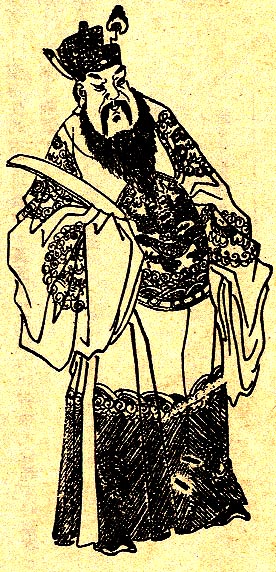
Last week I outlined Dong Zhuo's rise to power; it may be remembered that the rise of Dong Zhuo caused certain eyebrows to be raised. Among those that opposed Dong Zhuo's usurpation of power in the Imperial Capital of Luoyang was Cao Cao (style name Mengde). He left the Imperial Capital and removed to Chenliu (Southeast of modern day Kaifeng, Henan) and built up his army, joining with other regional warlords to form a coalition against Dong Zhuo in February of 190. Called the Guandong Coalition, the armies of thirteen prominent warlords gathered east of Hangu Pass. Cao Cao's forces served under Yuan Shao, who was elected leader of the coalition. 
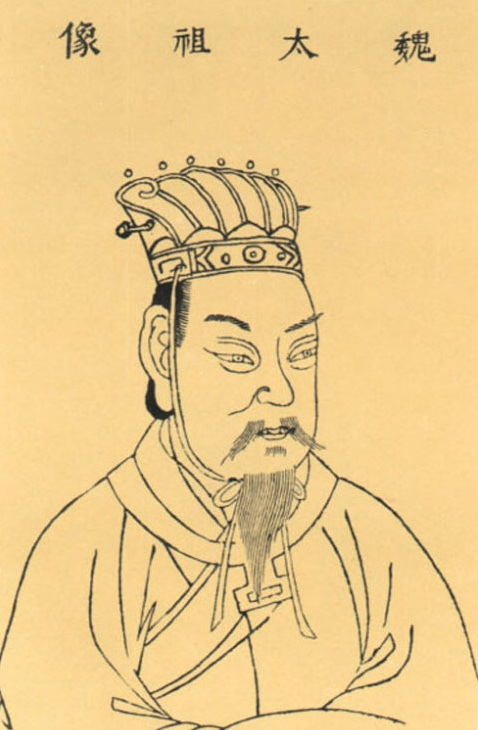
Cao Cao
The coalition forces blockaded the east of Luoyang, cutting off the eastern part of the Empire from the capital. This caused a massive reduction in tax revenue. To combat this, Dong Zhuo melted statues and other treasures for bronze to mint new coins, causing inflation throughout the empire.

Although the coalition forces arrayed before Dong Zhuo were impressive, they were made up of opportunists and family retainers with little or no battle experience. Yuan Shao too had limited participation in military affairs, whereas Dong Zhuo's forces were battle hardened veterans with experienced commanders. 

However, alarmed by the formation of the coalition, Dong Zhuo shifted the capital from Luoyang to Chang'an (modern day Xi'an, Shaanxi Province). On April 9 190, Dong Zhuo implemented his proposal, ordering his soldiers to loot the rich households of Luoyang and to drive the civilian population towards Chang'an. He forced the Emperor, nobles and officials towards Chang'an as well. Those who refused to obey the evacuation orders were executed on the spot. Dong Zhuo also ordered Lu Bu to raid ancient tombs and burial mounds for valuables. After the evacuation, Luoyang was burnt to the ground. 

Meanwhile, Cao Cao led his men westward to pursue Dong Zhuo's forces. He was defeated by Dong Zhuo's forces in the Battle of Xingyang, being wounded in the battle. 

At the same time, Sun Jian who had joined Yuan Shu (Yuan Shao's brother) with 20,000 to 30,000 was made the vanguard of Yuan Shu's forces. In March of 191 Sun Jian advanced to Liangdong, but was outnumbered and encircled by Dong Zhuo's general Xu Rong. With a few dozen men, Sun Jian fought his way through the encirclement and withdrew. 

Gathering his survivors, he advanced to Yangren, where he was met by a force sent by Dong Zhuo led by Hua Xiong, Hu Zhen and Lu Bu. Internal quarrels between Lu Bu and Hu Zhen led to the force being defeated, with Hua Xiong being captured by Sun Jian and executed. As Sun Jian advanced towards the capital of Luoyang, Yuan Shu feared that if he captured the capital he would be uncontrollable. As such, he stopped sending supplies to Sun Jian. Sun rode fifty kilometres in one night to reach Yuan Shu's base of operations, and convinced Yuan Shu to continue forwarding supplies to his troops.

Winning a further battle with Dong Zhuo at the battle of Dagu Pass, Sun Jian broke into Luoyang, where he routed the forces of Lu Bu. Whilst in Luoyang, Sun Jian found the Imperial Jade Seal in a well in the city. After having secured the city and sealing the tombs of the Emperors, he withdrew, fearing counter attacks.

Despite Sun Jian's successes against Dong Zhuo, the coalition was not unified enough to stand together against the warlord, and broke up later in the year.

In Fiction
Cao Cao's Assassination Attempt on Dong Zhuo
Wang Yun, a co-conspirator against Dong Zhuo lent Cao Cao a precious sword  to kill Dong Zhuo. Cao Cao went to Dong Zhuo's bedroom, and attempted to stab him in the back as he turned away for a mid day nap. However, the bed had a mirror so that Dong Zhuo could see behind him, and saw Cao Cao's attempt. Cao Cao quickly knelt in front of him and pretended to present the sword as a gift. After this, he fled the city a wanted man.

In Cao Cao's biography in the Record of the Three Kingdoms no mention is made of any assassination attempt.

Cao Cao is Arrested and Released by Chen Gong
Cao Cao fled Luoyang after his failed assassination attempt, and Dong Zhuo had notices for Cao Cao's arrest put up. He was spotted by the local magistrate Chen Gong and was arrested. In a private conversation, Chen Gong was impressed by Cao Cao's sense of righteousness, giving up his post and becoming Cao Cao's travel companion.

There is no mention of Chen Gong in the Record of the Three Kingdoms until 192, although Cao Cao was briefly arrested and released in Zhongmu County.

Cao Cao murders Lu Boshe
After fleeing with Chen Gong, Cao Cao sought refuge with Lu Boshe, who was Cao Cao's father's sworn brother. During their stay, Cao Cao overheard a conversation among the servants about whether to 'kill or to tie up first', and suspecting murder, he and Chen Gong indiscriminately killed everyone in the household. After finding out that the servants were actually talking about slaughtering a pig, they realised that they had killed innocents. Chen Gong and Cao Cao then fled the house. As they left, they ran into Lu Boshe, returning from an errand. When Lu asked them to stay, Cao Cao made an excuse, then killed him.

When Chen Gong asked him why, Cao Cao said 'If he goes home and sees his family dead, do you think he'll let us go?' when Chen Gong said that it is a 'grave sin to kill someone with the intention of doing so', Cao Cao said one of the most famous phrases in Chinese literary history: 

宁教我负天下人,休教天下人负我

"I'd rather wrong the world, than let the world wrong me". Chen Gong left him that night.

Although Cao Cao did in fact kill Lu Boshe's family due to a misunderstanding over a feast being prepared for him, Lu Boshe was not the sworn brother of Cao Cao's father, and Chen Gong was not with him - furthermore, he did not say the famous quotation above.

Battle of Sishui Pass
Sun Jian was crippled in front of Sishui Pass, due to Yuan Shu's refusal to send supplies. The general defending Sishui Pass, Hua Xiong, rode to the coalition camp and taunted them to dual him. After several generals were slain, Guan Yu, sworn brother of Liu Bei volunteered to fight Hua Xiong. Although Yuan Shu ridiculed him because of his low rank, Cao Cao intervened and told him to let Guan Yu go. Cao Cao offered him a cup of warm wine to bolster his spirit, but Guan Yu refused, saying that he would be back soon. He returned soon after with Hua Xiong's head while the wine was still warm.

This is a fictional battle invented by Luo Guanzhong. 

Battle of Hulao Pass
Dong Zhuo personally led an army to Hulao Pass, Lu Bu accompanying him. Lu Bu challenged the coalition forces to dual him in person. After killing a few generals, he was challenged by Zhang Fei, Liu Bei's sworn brother. As the battle was going poorly, Guan Yu joined in, followed soon after by Liu Bei, causing a three on one dual, which Lu Bu fought to a draw. This forced Dong Zhuo to withdraw to the west.

This is a fictional battle invented by Luo Guanzhong.

Tuesday, February 18, 2014

The Three Kingdoms Era - Rise of Dong Zhuo

The events described in this blog post are covered in episodes 2 to 3 of the 1994 edition of Romance of the Three Kingdoms, which can be found here

Last week we examined the Yellow Turban Rebellion - an uprising that saw the further diffusion of central Han power and the rise of local warlords. One of those local warlords that rose in stature during the period of the Yellow Turban Rebellion was Dong Zhuo. Commander of forces in Liang Province (modern day Wuwei, Gansu Province) Dong Zhuo was able to build his power base during and after the Yellow Turban Rebellion.

Dong Zhuo
In Fiction
There are a couple of fictional stories pertaining to Dong Zhuo that come out of the Romance of the Three Kingdoms. In the Romance of the Three Kingdoms, Dong Zhuo is said to have been defeated by rebel leader Zhang Jiao and his forces were being routed. Nearby, Liu Bei, Guan Yu and Zhang Fei were with their forces and came to Dong Zhuo's rescue. After the battle, Dong Zhuo asked the three brothers what positions they held in the government. When they responded with 'none', Dong Zhuo ignored them. 

This story is probably bollocks, introduced in order to firstly establish Dong Zhuo's character and to make the Three Brothers seem more noble in comparison.

In Reality
After Emperor Ling died in 189, the chief general He Jin (Overall commander during the Yellow Turban Rebellions) ordered Dong Zhuo to move troops to the Imperial Capital of Luoyang to eliminate the Eunuch Faction. Before he was able to arrive with his forces, He Jin was assassinated by the Eunuchs, and turmoil engulfed the city. Taking Emperor Shao hostage, the eunuchs fled the city, though ran into Dong Zhuo's forces and were stopped, Dong Zhuo taking the emperor back to the palace.

During the chaos, the General of Chariots and Cavalry, He Miao was killed for allegedly colluding with the eunuchs, and both He Jin and He Miao's forces came under Dong Zhuo's command. After Dong Zhou arrived in the city with his Liang Province troops, he also schemed to have Lu Bu kill his adopted father and Imperial Commandant of the Capital Guards, Ding Yuan, bringing Lu Bu under his command as his foster son. With fresh troops from Liang, combined with the capital guards and troops stationed in Luoyang under his control, Dong Zhuo became the target of the eastern warlords, who did not wish to have Dong Zhuo become influential. To counter their threat, Dong Zhuo had his forces march out of the city at night and reenter through the front gate at noon,  fooling the warlords that he had a massive army and cowing them into submission.

In 190, Dong Zhuo Emperor Shao and replaced him with the Emperor's brother, Liu Xie, who became Emperor Xian. Dong Zhuo declared himself Chancellor, and gave himself special permission to carry his sword to the Imperial Court, something that others were forbidden to do. He was also allowed to enter the court without removing his shoes. It is said that he even slept in the Emperor's bed and had sex with palace maids. 

Lu Bu

A sufferer of Chronic Backstabbing Disorder, Lu Bu was considered a great warrior of his age, though he was pretty bad as a commander of troops. Chen Shou, who wrote his biography in the Records of the Three Kingdoms said that he 'possessed the might of a tiger, but he lacked the planning skills of a talented person.' That about sums up Lu Bu. His role in Dong Zhuo's life will be seen later on, but at the current moment he killed his foster father, joined Dong Zhuo, then became Dong Zhuo's foster son.

Lu Bu. Look at dem helmet tail things.
In Fiction
In the Romance of the Three Kingdoms, Lu Bu is described as an invincible warrior but incapable leader. In order to get him on side, Dong Zhuo bribes him with gifts of weapons, promotions, women and most importantly, Red Hare, a horse said to be faster than any other under heaven. It was said to be capable of travelling over 1,000li (500 km) in a day, cross rivers and climb mountains like it was on flat land, and neighed like it had the ambition of 'soaring into the sky or diving into the sea'. Basically, Red Hare was a Skyrim Horse.

Most of this portrayal is an exaggeration of the facts of Lu Bu's life - certainly, the Red Hare was valued enough to be rewarded as a gift following Lu Bu's death, but it definitely wasn't a Skyrim horse.

Tuesday, February 11, 2014

The Three Kingdoms Era - Yellow Turban Rebellion

Thus far in this blog series I've been going through the eras in Chinese history at a breakneck pace. The original intention had been to give a broad overview of each dynasty and era, and then go back and fill in the blanks later on. However, I'd not expected at the start of the series to have rediscovered my love for the Romance of the Three Kingdoms, so we're going to be spending a few weeks examining this period in detail. So this week we look at the event that kickstarts the Romance of the Three Kingdoms: The Yellow Turban Rebellion

Before I get cracking, I'd like to note that if this interests anyone, you can find a very accurate portrayal of the Romance of the Three Kingdoms online here. The subtitles are terrible, but that's just part of the fun! Keep in mind that the Romance of the Three Kingdoms is a historical novel, and is 50/50 fact/fiction at best.

So like I mentioned in the previous post, the Eastern Han Dynasty was beset by all manner of problems, including corruption, a loss of central power, heavy burdens of taxes and so on. In 184 CE, the Yellow Turban or Yellow Scarves Rebellion broke out, so called because of the scarves they wore on their heads. Led by three brothers (Zhang Jue, Zhang Bao, Zhang Liang) of the Daoist sect the 'Way of Supreme Peace', the uprising caused massive disruptions to Imperial Commanderies throughout the North of the Empire, near modern day Beijing and even threatening the Imperial Capital of Luoyang (Modern day Luoyang, Henan Province). For the first few months of 184 the rebels steadily gained ground, pushing back Imperial forces wherever they met them. By the middle of 184 however, the Imperial forces had pushed back the rebels and besieged them in the city of Wan (near modern day Nanyang, Henan Province) capturing the city and putting the rebels to the sword in 185. Although this ostensibly ended the rebellion, later in 185 more rebellions broke out, not fully ending as a military threat until 205. In 192 the Warlord Cao Cao (he'll be important later) gained the submission of a rebel army in Yan Province.

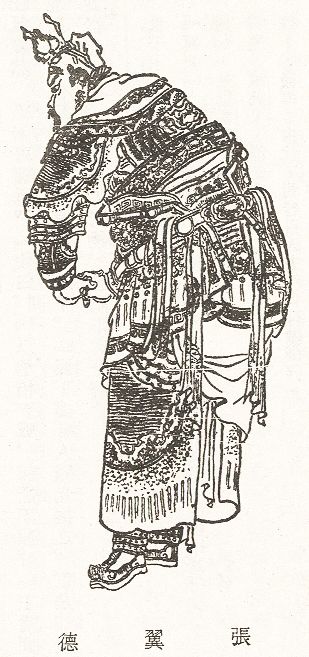
In the middle of all of this slaughter and fighting three very important figures step onto the stage. As the call to arms went out from the central government, a distant Imperial Uncle, Liu Bei (style name Xuande) meets Guan Yu (style name Yunchang) and Zhang Fei (style name Yide). According to folklore, the three swear an oath of brotherhood in a peach garden, and go off to fight the Yellow Turban Rebellion.

In reality, history tells us that the three were close like brothers, often sleeping in the same bed, but say nothing about an actual oath of brotherhood. These three people are important because later on in the Three Kingdoms era Liu Bei goes on to form the Kingdom of Shu-Han in the west of the nation. Guan Yu in particular was deified following his death, and is the God of War and of Bean Merchants (not making this up) in the Chinese cosmology.

Liu Bei from a Tang Dynasty print
Guan Yu
Zhang Fei
Two very important things came out of the Yellow Turban Rebellion. Firstly, the rebellion was widespread, and ended in the sack of many government centres, and also resulted in the deaths of a large number of Imperial Magistrates. Secondly, the local generals and warlords who were instrumental in putting down the rebellion were given local military and administrative power, further diluting central authority and hastening the end of the Eastern Han Dynasty.

Tuesday, February 4, 2014

Eastern Han Dynasty

The Eastern Han Dynasty was founded after by Emperor Guangwu of Han in 25 CE, following the overthrow of Wang Mang's Xin Dynasty. Guangwu established the Imperial Capital in the modern city of Luoyang, Henan Province. Though it started off on a high note, with the height of the Empire coming in the reign of Emperor Zhang (75-88 CE), the Eastern Han was founded on much weaker foundations than the Western Han. Emperor Guangwu was forced to rely on the big landholding families in order to gain power - and he was largely unable to centralise power back to the extent that it had been under the Western Han Empire.

Emperor Guangwu
Additionally, following the reign of Emperor Zhang, the Royal Family increasingly fell under the influence of the Eunuch Faction. Though eunuchs had been present in the Western Han Dynasty (Sima Qian, the author of Records of the Grand Historian was a eunuch), they began to hold larger and larger influence, in the same way that the families of Emperors' wives were able to acquire power over the course of the Western Han Dynasty. In fact, the eunuchs were often in conflict with the families of these great families, and over time the power struggles came to dominate the internal affairs of the Imperial Court.

In terms of foreign policy, the Eastern Han were able to largely maintain their holdings in northern Korea and Vietnam, along with finally ending the Xiongnu threat in the north through a series of military campaigns. Han power and culture were projected along the Silk Road, reaching as far as Central Asia and maintaining contact with the Parthian Empire of modern day Near Asia, along with civilisations in India. In CE 97, the Han organised an attempt at reaching Da Qin (Rome), but reportedly got as far as the Southern Mediterranean before turning back; in CE 166 a Roman embassy from Emperor Marcus Aurelius (likely merchants) did reach the court of Emperor Huan, though any interactions between the two great Empires on opposite ends of the Eurasian continent did not get more intricate than that.

Despite these foreign policy successes, the corruption in internal matters eventually weakened the central authority of the Imperial Court greatly. The eunuch faction's propensity to auction off court positions caused offense with the bureaucrats, who were further alienated when Emperor Huan (125-144 CE) sided with the eunuchs.

By the time the Yellow Turban and Five Pecks of Rice (I swear I am not making these names up) Rebellions flared up in 184 CE, the power of the central government was weak enough that the courts were forced to rely on regional strongmen to raise forces to combat these rebellions - a decision that saw warlords springing up all over the country, and leading to the Three Kingdoms era.

NEXT WEEK: An overview of the Three Kingdoms era.

Tuesday, January 28, 2014

Xin Dynasty

Following the rule of Han Wudi, the fortunes of the Western Han Dynasty began to wane. The failure of successive Emperors to reduce the power of land owning families in the West of the Empire in Guanzhong (the old stronghold of the Qin Dynasty) would prove to be a decisive blow, not only against the Western Han, but eventually the Eastern Han as well. Successive families managed to take practical control of the Imperial Court, as Empress Dowagers and Imperial Consorts forced isolated Emperors to promote family members to positions of power. It was in this situation that Wang Mang entered. His story is one that reflects the successive waves of power that the noble families in China enjoyed over the course of decades.

Wang Mang
Initially the Wang clan was powerful in Chang'an, the capital. They dominated affairs in the Imperial Court, and members of the Wang clan held high positions throughout the Empire. However when Emperor Cheng died, the Wang clan was supplanted by another great family, and Wang Mang, who at this stage was already an official in a high position, retired to an out of the way post.

In 1BCE however, Emperor Ai died suddenly without heir, and Grand Dowager Empress Wang summoned Wang Mang back to court, putting him in charge of the government and the military. From this position, Wang then began to shore up his support, demoting relatives of Emperor Ai and inducing the deceased Emperor's allies to suicide or exile.

He then began creating a personality cult by spreading rumours that he was the second coming of famous ancient figures through Chinese history, such as the Duke of Zhou. When his son, fearing for when the new Emperor would be old enough to resent Wang Mang's actions, began to agitate against him, Wang had him and his co-conspirators executed.

Around 5CE, Wang Mang had the Emperor Ping poisoned, and then stood in as Acting Emperor while searching for a successor. In 8CE, Wang Mang overthrew the Han Dynasty, and pronounced the Xin (New) Dynasty.

In many ways this represented both a break from the past and a return to it. Wang Mang modeled his new Empire on the Sage Kings of the past. It was an attempt to return to some 'golden age' in Chinese history, though his reforms were not fully realised to this effect. In an attempt to break the power of the major land holding families, Wang Mang brought all land under the control of the central government. He issued 28 types of coins, a complete disaster that caused easy counterfeiting and general confusion in the coin based economy.

A general failure in foreign policy also caused tensions with the Xiongnu tribes in the north west and with Korean vassal states.

Eventually in an attempt to improve the position of the imperial coffers, Wang Mang issued a state monopoly on liquor, iron, salt, coinage, forestry and fishing. However, due to Imperial corruption, the position of the coffers was not much improved.

Wang Mang was overthrown in 23CE, killed in the sacking of the capital by armies of the restored Eastern Han Dynasty. He was the first and only ruler of the Xin Dynasty.

Wednesday, January 22, 2014

The Western Han Dynasty

Having soundly defeated Xiang Yu in the Chu-Han Contention, Han Liu Bang established the Han Dynasty. Considered one of the high points of Chinese civilisation, the Han Dynasty has left its mark on Chinese history and culture. The majority ethnic group in China today is the Han. The language of China is known as 汉语 or the language of the Han. Chinese characters are known as 汉字 or Han characters.

Despite having decried the Qin Dynasty as being overly cruel and harsh to the people, the early Han law codes borrowed heavily from the Qin Legalist system. When Liu Bang overthrew Xiang Yu and set up the Han Dynasty, he instituted a system of 13 commanderies ruled directly by him and his court, and established 10 semi-autonomous kingdoms in the East of his empire, rewarding land to those who had assisted him in his conquests. However, over the course of his reign and the reign of his successors, these independent kingdoms were induced to rebellion, and were slowly brought back into the fold, their kings replaced by members of the Liu family. By the time of Liu Bang's death in 195 BCE, his Empire consisted of 16 commanderies.

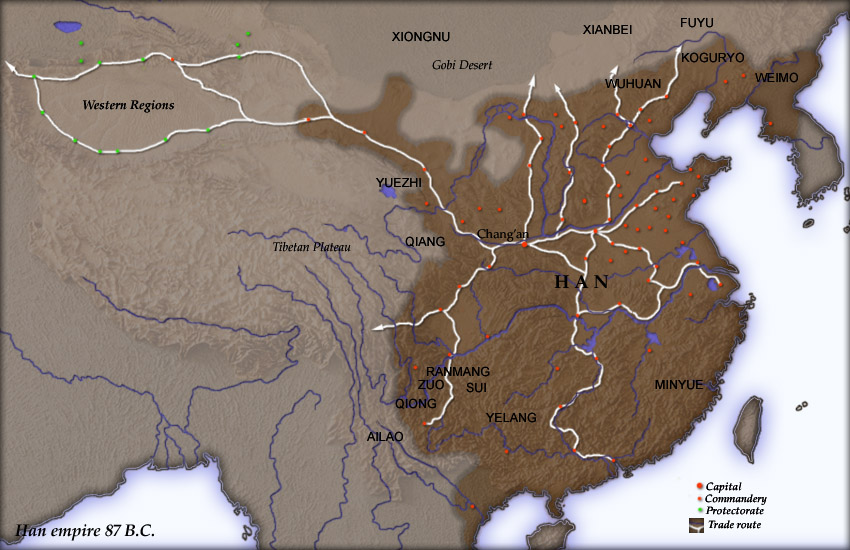
The Empire in 87 BCE
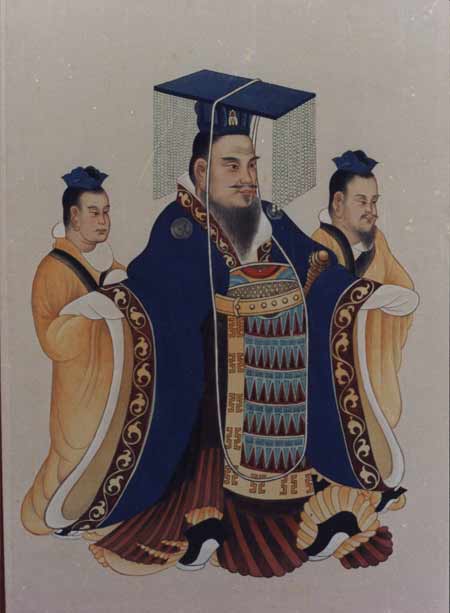
The high point of the Western Han Dynasty came during the rule of Liu Che, or Han Wudi, who ascended the throne in 141 BCE. Initially his grandmother ruled the Empire in his stead, but upon her death in 135 BCE, Han Wudi proceeded to make his own mark on the Empire.

Han Wudi
The first thing he did was take Dong Zhongshu into his confidence, and proceeded to overturn the old Legalist system, replacing it with a Confucian variant. Initially Confucianism had been a simple secular ruling philosophy, teaching filial piety and respect for authority. Under Dong Zhongshu, Confucianism was mixed with aspects of Daoism and Legalism, fusing the ethical though of Confucianism with the ideas of Yin and Yang, along with a cosmological framework into which fit Heaven, Earth, the Empire and the Emperor.

Having thus reformed the civil service, Han Wudi also expanded upon institutions made by Liu Bang. He formed the precursors to the later civil administration exams, ensuring that it was possible for promotion by merit, rather than birth.

The biggest legacy left by Han Wudi, however, was his military expansion. From 133 BCE until the end of his life, Han Wudi launched a series of campaigns aimed at expanding Han China's borders to the north and west, fighting the Xiongnu Confederation, a nomadic people of the steppe. Over a series of campaigns stretching from 133 BCE to 108 BCE the Han scored a series of victories that firmly established Han dominance of the North and West.

The campaigns continued until well after Han Wudi's death, ending in 89 CE.

Ultimately, the campaigns launched by Han Wudi ended up stretching the national treasury, and following his death in 87 BCE, the Western Han Dynasty began a long decay that ended in Wang Mang's Xin (or new) Dynasty.

Next week, we examine Wang Mang's Xin Dynasty!

(P.S. The reign of Han Wudi also saw the works of Sima Qian, known as the Grand Historian, published. He is the first historian in Chinese history)

Tuesday, January 14, 2014

The Chu-Han Contention

The Fall of Qin

With Qin Shi Huang's death in 210 BCE, the strong man who had unified China was gone. His sons were not up to their fathers' task, and the rise of Qin Er Shi in 210 BCE to the throne sparked a variety of rebellions. The first was in 209 BCE, which was put down by the Qin armies. However, this rebellion inspired a variety of others, and by the end of the year, most of the Qin Empire was in open rebellion, often led by those who claimed to be successors to the states that Qin had conquered to form the Empire.

Liu Bang

Liu Bang
Liu Bang was one such rebel leader. Nominally an underling of the state of Chu, Liu Bang was the one to march on the Qin capital in 206 BCE, forcing the surrender of Emperor Ziying (Qin Er Shi had been killed off and removed from the throne after his incompetence became clear). This marked the end of the Qin Empire, but not of the end of the chaos in China.

Said to be born in 256 BCE, Liu Bang was not from a noble family. Raised as a peasant, he had little time for the mannerisms and customs of the nobility. He rose to some prominence in his own little corner of the world, but when some slaves that he was tasked with escorting to construct Qin Shi Huang's mausoleum escaped, he freed the rest of them and became a fugitive to avoid the death sentence.

In 209 BCE with the first rebellions against the Qin, Liu Bang returned to his hometown of Pei County, and following the murder of the local magistrate by the civilians, declared himself Duke of Pei. In 208 BCE, Liu Bang swore himself to the service of Chu, and was granted the title of Marquis of Wu'an. At this point he was given an army and tasked with attacking Qin. To up the stakes, the King of Chu declared that the one who reached the capital first would be given the title of King of Guanzhong. The main contenders were Liu Bang and Xiang Yu, a general of Chu.

Liu Bang arrived first, and Ziying surrendered to him. By rights he should have been raised as King of Guanzhong as promised. However, Xiang Yu arriving second, was not content. He had the larger army, and the better connections, coming from a prestigious military family of the old Kingdom of Chu. At an event called the Feast at Hong Gate, he attempted to have Liu Bang assassinated several times, but each time was foiled.

Liu Bang, begging the use of the latrine, fled with his men west.

Xiang Yu

The opposite number of Liu Bang during the Chu-Han contention, Xiang Yu was a general and nobleman. Following the flight of Liu Bang, Xiang Yu, the strongest of the various warlords who had cropped up, broke the former Qin Empire into 18 parts, declaring himself ruler of 'Western Chu'. Liu Bang was instead relocated to Hanzhong in modern day Shaanxi, and given the title King of Han.

Modern day Hanzhong Prefecture
Xiang Yu was an able general, though cruel and rather ruthless (the accuracy of the stories of his cruelty are difficult to take at face value, however, due to his defeat by Liu Bang). Unlike Liu Bang who relied on more able advisers and generals, Xiang Yu instead tended to rely on his own ability. Where Liu Bang was charismatic, Xiang Yu was competent.

Xiang Yu

The Chu-Han Contention

When Liu Bei arrived in Han Zhong, he had the galley roads (wooden planks cut into the sides of the cliffs) destroyed, both to prevent future assaults into his territory and to convince Xiang Yu that he was content in his position.

When the new state of Qi rose in rebellion against Xiang Yu's hegemony in 206 BCE, Liu Bang seized the opportunity. At the behest of his general Han Xin he attacked Guanzhong, defeating the three former Qin generals who ruled there. 

In response to this, Xiang Yu sent an army against Liu Bang, and declared Zheng Chang as King of Hán. In the following year, Liu Bang moved against the states occupying the modern province of Henan, and the kings of Sai, Di and Henan all surrendered to him. However, Zheng Chang did not, and was defeated by Liu Bang's general Han Xin, and replaced by him as King of Hán.

The defeat of the Qi rebellion in the same year allowed Xiang Yu to concentrate on his Western border. However, by failing to appease the people and allowing his army to loot and plunder the state of Qi, he encouraged more rebellions, leaving a dangerous situation on his northern flank.

Seizing advantage of this, Liu Bang advanced on the Chu capital of Pengcheng with a large force and captured it. Official records state that he had an army of 550,000 with him on his march, raised from his own reserves and those of the surrendered kings. 

Hearing of the fall of Pancheng, Xiang Yu rushed back with a force of 30,000, surprising Liu Bang with a sudden attack and inflicting large casualties on Liu Bang's forces, and inducing Liu Bang to withdraw with only a small bodyguard. In the confusion, he also captured Liu Bang's family.

Following this battle, many of the surrendered kings defected to Chu. Things were looking pretty bleak for Liu Bang.

In the latter half of 205 BCE, Liu Bang's general Han Xin managed to open a northern front against Xiang Yu in a series of battles that saw Han Xin crowned as acting King of Qi in 204 BCE. Liu Bang, then besieged in Xiangyang (near modern day Zhengzhou, capital of Henan Province) managed to sleuth his way out of the siege, spreading rumours that made Xiang Yu dismiss some of his able advisers, before attacking Chenggao (also near modern day Zhengzhou). Combined with the successes of Han Xin in the north, this forced Xiang Yu to the negotiating table, where Liu Bang and Xiang Yu agreed to split China between them along an East-West axis. This is known as the treaty of Hong Canal which was signed in late 204 BCE.

In 203 BCE, whilst Xiang Yu was retreating eastwards, Liu Bang broke the treaty and attacked, requesting aid from his allies Han Xin and Peng Yue to form a three pronged attack on Xiang Yu. However, his allies did not mobilise their troops, and Liu Bang was defeated in the battle of Guiling (near modern day Zhoukou in Henan Province). 

Forced to retreat, Liu Bang sent messengers to Han Xin and Peng Yue, promising them titles if they assisted him. And so, in 202 BCE, armies advancing along three routes led by Han Xin, Peng Yue and Liu Bang attacked Xiang Yu again, trapping him in Gaixia (near Suzhou, Anhui province). Han Xin instructed his men to sing Chu folk songs to create the impression that Chu had already fallen to Han forces.

Many of Xiang Yu's deserted him as supplies ran low and morale plummeted. Even Xiang Yu's favourite concubine committed suicide, blaming herself for his defeat (She had been captured and used as bait to draw Xiang Yu into the trap). Finally, with 26 loyal retainers Xiang Yu broke out of the encirclement, and reached the north bank of the Wu river, where he made a last stand as his retainers were sent across the river, killing several Han soldiers before committing suicide.

With his death, Western Chu surrendered to Liu Bang, allowing him to unify China again and declaring the beginning of the Han Dynasty in 202 BCE, with his capital in Chang'an (modern day Xi'an, capital of Shaanxi Province). 

Next Week: IT'S FINALLY TIME! THE BIG (well one of them anyway) ONE! THE ONE WE'VE ALL BEEN WAITING FOR! THE HAN DYNASTY!