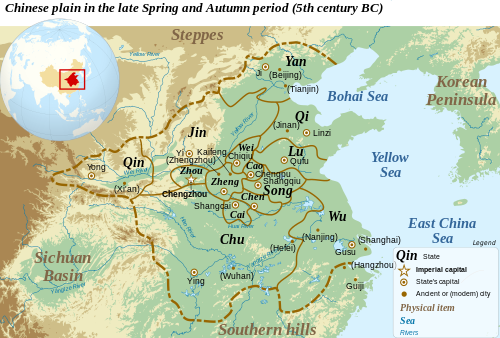
By the end of the Spring and Autumn Period, the various hundred odd states that existed in China had been whittled down to just seven: Qin in the west, the successor states of Jin (Zhao, Wei, Han) in the centre, Yan and Qi in the east and Chu in the south. The Zhou Dynasty kings were still technically in charge, and had their own little bit of territory near modern day Luoyang.
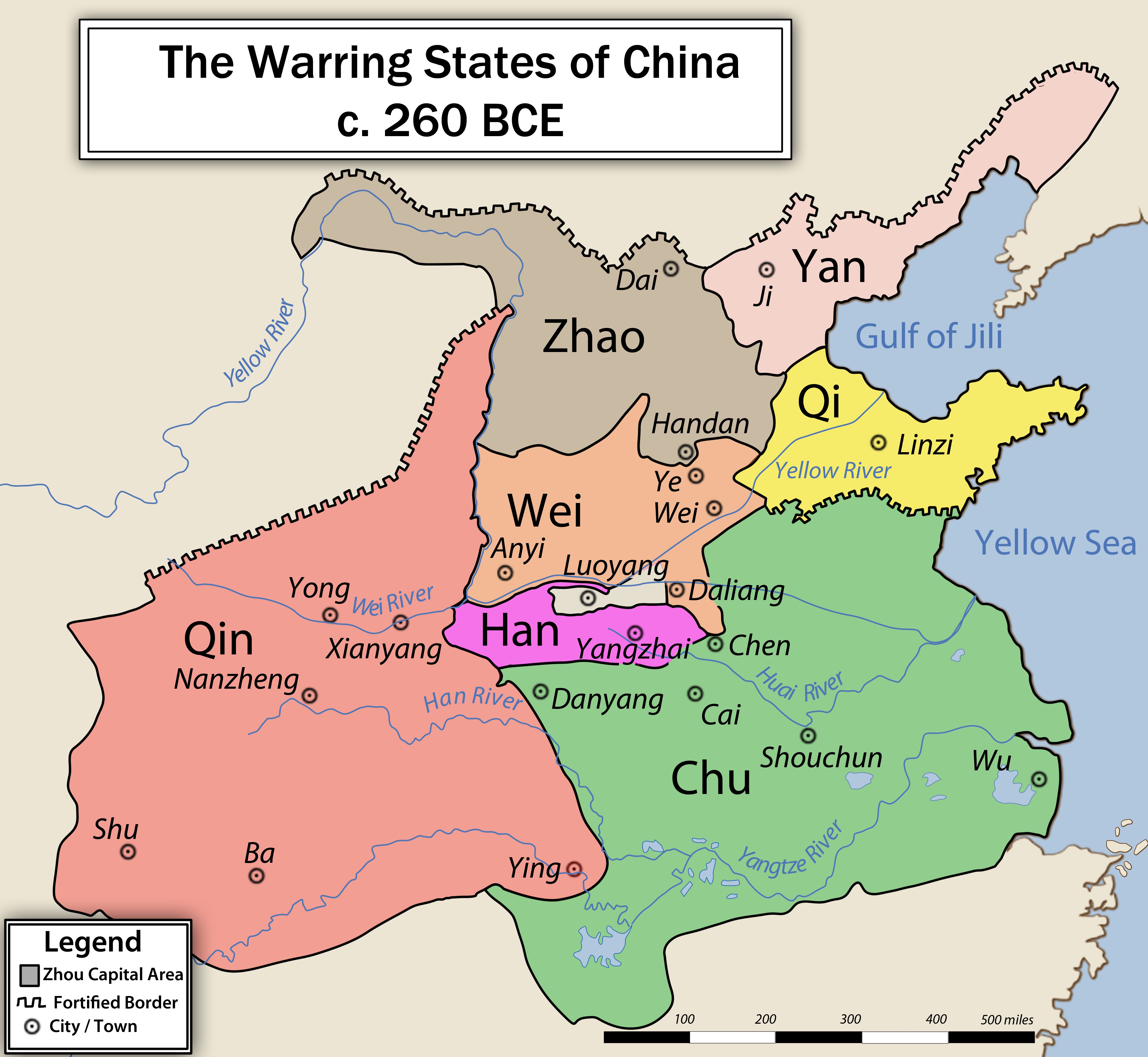
What's important to understand about the Warring States period is that, unlike the previous Spring and Autumn period, despite having more years of peace, the scale of war became increasingly larger, along with the casualties sustained by the various warring states. The exact date on which the Warring States period starts is a bit murky, as there lacks a clear event that marks the start time, unlike the fall of the Western Zhou Dynasty for the Spring and Autumn. Various dates have been suggested, from 481 BCE, which marked the end of the Spring and Autumn Annals, to 403 BCE, when the three states of Zhao, Wei and Han were recognised by the Zhou court. However, I personally prefer the date 453 BCE, which is the year in which Jin was partitioned into its three successor states. The period ends in 221 BCE, with the conquering of Qi by Qin armies, and the formation of the Qin Dynasty, the first dynasty that ruled over a unified China.
The Warring States Period is one of increasing bloodshed and destruction as the various states raise massive armies in their conquests of each other. Official numbers are generally thought to have been inflated, in order for the Han Dynasty to paint a picture of an extremely bloody period prior to unification. Remember that King Wu of Zhou had overthrown the Shang Dynasty with a force of 45,000 infantry and 300 chariots. Official figures for military might in the Warring States Period list the state of Qin as having an army of 1,000,000 infantry, 1,000 chariots and 10,000 horses. These numbers should be taken with a bucket load of salt, since they are likely inflated, but what can be inferred from this is that the scale of warfare increased at massively during the Warring States Period.
In terms of military technology, three things stand out. Firstly, the increased usage of iron in the process of forging weapons and armour, the invention of the crossbow, and the increased usage of cavalry to replace chariots. Although the primary metal used in the period was mainly bronze, at some point over the course of the 200 odd years of the Warring States Period, states shifted towards the usage of iron over bronze. The invention of the crossbow at some point during the 500s or 400s BCE enabled a shift away from aristocratic forms of chariot warfare, and towards the sorts of mass infantry armies that have become ubiquitous with perceptions of China. The decline of the aristocracy as a leader in terms of war making also enabled the development of dedicated cavalry forces, which were generally superior to chariots in that they were a more versatile fighting force.
The Warring States Period also saw a general spread in military philosophy, just as the Spring and Autumn had witnessed a plurality of moral and political philosophical thought. Of the Seven Military Classics of Ancient China, four are said to have been written during the Warring States Period. These are the Methods of the Sima, Wu Qi's Wuzi, Wei Liaozi, and the Three Strategies of Huang Shigong.
In terms of cultural development, the decreasing in stature of the aristocracy allowed for the development of a bureaucratic state, and the groundwork for the future Chinese bureaucracy were lain during the Warring States and Spring and Autumn periods.
Sun Bin
Said to have been a descendant of the famed Sunzi, Sun Bin (??? - 316 BCE) was a famed strategist of first the state of Wei, and then the state of Qin. Sun was tutored in military strategy by the hermit Guiguzi, and was considered to have been his best pupil. During his time with the hermit Guiguzi, he was good friends with another student named Pang Juan, and the two of them became sworn brothers.
Pang Juan soon left the tutelage of the hermit Guiguzi, and went off to the State of Wei, which he heard was recruiting talented men in order to conquer 'all under Heaven'. After a few years, with his star on the rise, he invited Sun Bin down to the State of Wei. But he was actually jealous of Sun Bin, who he knew to be the better general, and so he framed him for treason, and reported him to King Hui of Wei, who then ordered Sun Bin executed. Pang Juan pretended to be on Sun Bin's side, pleading for amnesty, and so the punishment was 'reduced' to face tattooing, and removal of Sun Bin's kneecaps.
Pang Juan then pretended to take pity on Sun, and treated him quite well, though he was in fact trying to trick Sun into writing a military book, after which he would have the man executed. Well, Sun figured this out, and decided to feign madness. Pang, not believing it, tried to test Sun's madness by locking him up in a pigsty, to which Sun pretended to be having fun and even ate pig feces. And so Pang stopped keeping an eye on him, allowing Sun to escape to Qi, where he eventually ended up as Chief Military Adviser.
In 354 BCE, Wei attacked Zhao, with Pang Juan at the head of the army, besieging the Zhao capital of Handan. Zhao asked Qi for help, and the King of Qi commissioned Sun Bin as military adviser, and Tian Ji as General to lead an army to assist Zhao. Knowing that a direct attack on Wei forces would be unwise, Sun proposed to attack Wei in order to relieve the pressure on Zhao.
In the Guiling Campaign, Sun first initiated a scattered series of attacks on Wei forts, all of them failing and luring Pang Juan into a sense of security, causing him to pool forces in the attack on the Zhao capital. Sun then had the Qi army attack the capital of Wei, Daliang. When word reached Pang at the Zhao Capital that Daliang was under attack, he marshaled a force to relieve the siege, and was decisively beaten at the battle of Guiling, where Sun Bin had prepared an ambush. From this campaign comes the 2nd of the thirty six stratagems - "Besiege Wei to Rescue Zhao".
Pang managed to escape back to Wei, despite the destruction of his forces.
The second of Sun Bin's two famous campaigns, the Maling campaign took place in 342 BCE, when Wei attacked Han, and Han turned to Qi for assistance. Giving the impression that Han could depend on Qi's army for assistance, Han went all in against Wei, though the promised help never materialised. After a year of resistance, Han was no longer able to maintain its armies, and again asked for help from Qi. Again, instead of assisting Han directly, Sun advised to strike at the Wei capital of Daliang.
Having learnt from his mistake in the previous Battle of Guiling, Pang Juan (annoyed at having been recalled from the war in Han a few weeks away from taking the Han capital) ordered his 100,000 strong army to go around the Qi forces, to avoid ambushes, and also ordered his troops to return to the capital hastily, before Qi could set up any good ambushes.
Sun however, just sat and waited, rather than rushing around to attack the high morale Wei army. He then split his force, sending the majority of it back towards Qi to prepare the necessary materiel for ambushes, whilst he personally led a force to face Pang Juan. When the two armies came close to each other, Sun immediately ordered a retreat towards Qi.
Along the way, he ordered his army to reduce the number of stoves used for cooking day by day. Judging from the dwindling number of campfires, Pang Juan assumed that the Qi army was deserting, and so led a smaller, elite cavalry force to give chase. As the Qi army retreated back into their own territory, Sun then ordered the men to abandon some of their baggage. When Pang Juan's force happened upon this, they assumed that there existed a state of confusion in the enemy ranks.
When the Qi army arrived at Maling, Sun Bin noticed a narrow path that could be used for an ambush, and so, judging that Pang Juan would arrive at nightfall, ordered his men to prepare for battle. Chinese folklore has it that he also ordered his men to inscribe on a tree "Pang Juan shall die in Malingdao, under this tree".
When Pang Juan arrived with his army, he was lured into the ambush, and, knowing that the battle was lost and escape impossible, took his own life.
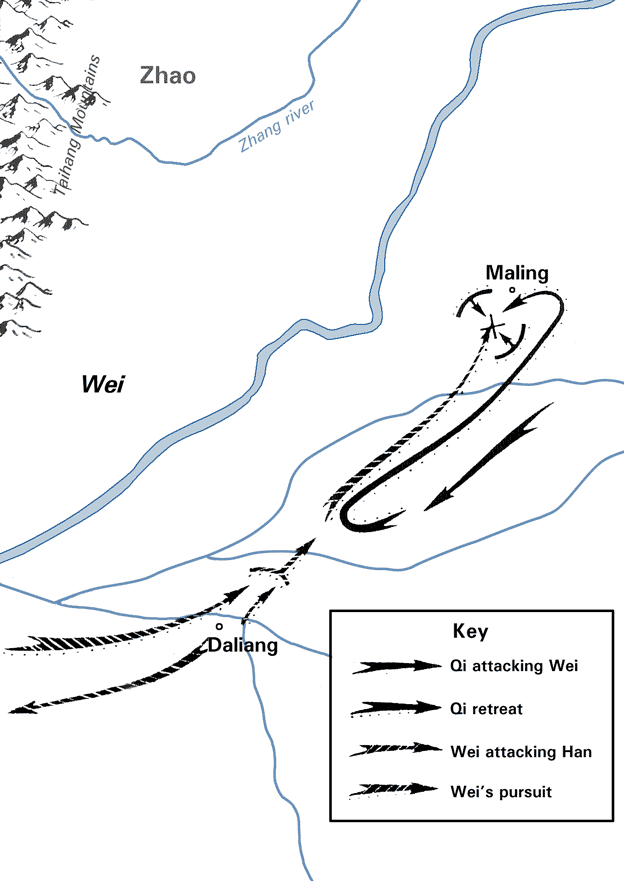 |
| Map of the campaign |
The campaigns of Sun Bin reflect the trends of Chinese warfare found in the Art of War. Firstly, he focused mainly on the strategic aspects of the campaigns, willing to take defeats on a tactical level to shape his strategic goals. Secondly, he relied heavily on maneuvre to force Pang Juan to fight him on his own terms, attacking strategic ground and remaining agile in order to defeat a larger force. Third, as the retreat towards Maling shows, he made good use of 'shaping operations' in order to fight on the most favourable terms to him, engaging in ground of his choosing against an enemy tired out by pursuit. Finally, his heavy usage of deception in the Maling campaign reflects the famous Sunzi quote:
"All warfare is based on deception"Next week I'll be taking a look at the Qin campaigns of unification, where we start to get into the proper, unified Chinese Dynastic history. Hope you enjoyed this blog post!