Showing posts with label Qin. Show all posts

Wednesday, January 8, 2014

Rise of the Qin

The Qin Wars of Unification

In 247 BCE, Ying Zheng ascended to the throne of the State of Qin. Being 13 years old at the time, he did not wield proper power until 238 BCE, when he eliminated his political rivals. With help from his chancellor Li Si, Ying prepared a plan to unify China.

In 230 BCE the state of Qin launched a campaign of conquest against the state of Han, considered to be the weakest of the Warring States, and devoured it completely within the year. What followed were a series of conquests that lasted until 221 BCE, when, one by one, the individual states of China fell to the armies of Qin.

When the state of Qi at least surrendered to Qin in 221 BCE, Ying Zheng declared himself Qin Shi Huang, or the First Emperor of Qin, and became the first ruler to lord over a united China.
The Unified Qin Empire

Qin Shi Huang

Qin Shi Huang can be compared with two other (famous) figures in Chinese history - Cao Cao, and Mao Zedong. Born in 260 BCE, the man who would one day unify the Warring States was brought up in the state of Qin. The reign of Qin Shi Huang is noted in popular history for several important things.
  1. Its cruelty
  2. The construction of the (first) Great Wall
  3. The unification of weights and measures
  4. The unification of the written language
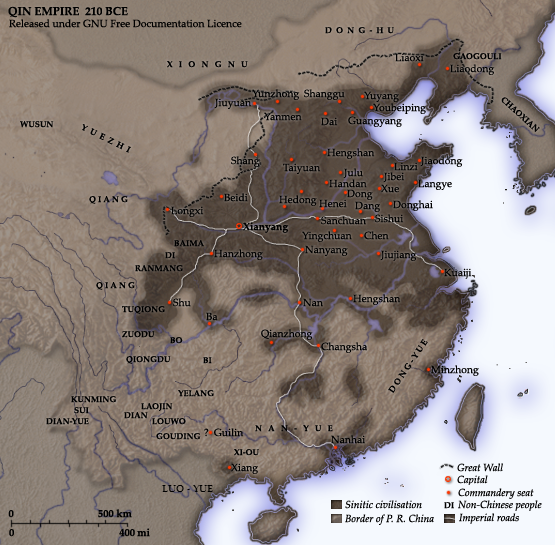
Though the Dynasty founded by Qin Shi Huang lasted only 15 years, it would have a lasting impact on the history of China. Indeed, the name 'China' itself can possibly be traced to the Qin (pronounced Chin), as a corruption of Central Asian terms for the Qin Empire.

The reign of Qin Shi Huang introduced the above four things to China. It also introduced to history a flawed man who likely killed himself looking for the Elixir of Immortality.

There were positives too, among all the misery and suffering. The bureaucracy was greatly expanded under the reign of Qin Shi Huang, and the old Feudal system, whilst not abolished, was greatly reduced in emphasis. Though the famed examinations were not implemented during the Qin Dynasty, governmental reforms made it easier to promote both military and civil administrators based on merit, rather than familial connections.

Confucianism and Daoism were suppressed - Legalism was the state philosophy, though Qin Shi Huang did allow for Daoist religious practice. As part of this, the 'Hundred Schools of Thought' was suppressed - and and many books were burnt, scholars who refused to give them up, buried alive in 213 BCE. There is some skepticism as to how extensive this book burning program actually was, as most of the alleged cruelty was against the scholars - the people who ended up writing the history of the Qin Dynasty from the safety of the Han Dynasty.

The Great Wall was originally 'constructed' during the Qin Dynasty as well. Not the stone monstrosity that you can visit today, the Qin Great Wall was a series of earth ramparts and clay fortifications, largely already constructed, that Qin Shi Huang ordered connected in order to secure the northern border. 

After three assassination attempts, Qin Shi Huang became paranoid and obsessed with finding the Elixir of Life, and employed a variety of Daoist priests who gave him elixirs that had a lot of mercury in them, ironically likely shortening his lifespan.

Eventually, he gave up with the whole idea of living forever in flesh, and started big projects, like the Terracotta Warriors and his tomb (which to this day has yet to be opened) which would allow him to rule for 'ten thousand years' in spirit form.

He died in 210 BCE at the age of 50, still on the quest for the Elixir of Immortality. His empire fell apart 4 years later, in 206 BCE.

Short-ish entry today, will have more to talk about next week with the Han-Chu contention.

Wednesday, December 18, 2013

The Spring and Autumn Period

The Spring and Autumn period represents the zenith of Chinese philosophy and political thought. The decline in power of the Zhou Kings and the resultant rise of many disparate states formed an atmosphere where political and philosophical thought would be able to flourish in ways that would not be seen in China for centuries.

The Spring and Autumn is the period of Confucius, Laozi, Mozi and Sunzi. It saw the rise of the four main schools of philosophical thought that dominated the Spring and Autumn and the Warring States periods; Confucianism, Taoism, Mohism and Legalism. Of the two, only Confucianism and Taoism survive in recognisable form today.

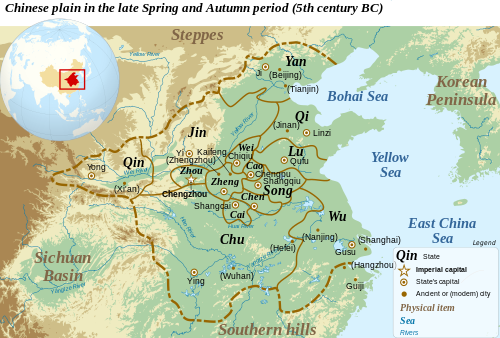
Following the sacking of the Zhou capital at Zongzhou near modern day Xi'an by the Marquess of Shen and his Quanrong barbarian allies, the Zhou moved their capital eastwards, to Chengzhou in the Yellow River valley. This marked the ending of the Western Zhou Dynasty, and with it the ending of central Zhou authority. During the period in which the Zhou had consolidated their power upon ascending to primacy in China, states in the East had been carved up and given to members of the royal family. Though this had kept those potentially volatile states under Zhou control, by the fall of Zongzhou states that had once been ruled by royal brothers were now ruled by third and even fourth cousins.

Further complicating matters for the Zhou was the fact that their new capital was removed from their traditional power base in the Wei river valley. This double blow of a military defeat, combined with the removal of their power base meant that the Zhou were essentially reduced to a figurehead ruler of China.

The shifting of the capital occurred in 771BCE, and that is typically the date that historians associate with the beginning of the Spring and Autumn period. The name of the period comes from the Spring and Autumn Annals, a chronicle of the state of Lu between 772 and 479BCE. Traditionally, this piece of literature is ascribed to Confucius, but in reality was likely put together by chroniclers from the state of Lu.

Courtesy of Wikipedia
Over the course of the Spring and Autumn period, some 148 states rose, though were eventually unified by one of the seven major states that would arise by the Warring States period. The Spring and Autumn saw several important changes to the traditional Chinese methods of governing.

Firstly, the Feng Jian or Feudal system that had been in place during the Western Zhou dynasty was rendered obsolete. The rendering of the King of Zhou to a figurehead meant that real power lay in the rulers of the various states that were now vying for hegemony in China.

Secondly, the rise of these various states led to the development of a hierarchical alliance system. In it, the strongest state leader would be given the title of Hegemon or ba, who would be obliged to protect the weaker Zhou states and the Zhou royalty from intruding armies. Whilst this still had shades of the old Feng Jian system, in reality the Zhou royalty were not as important in the determination of the hegemon as might be implied.

Thirdly, the rise to power of the first hegemon, Duke Huan of Qi (Qi Huan Gong) was due largely to reforms passed by his adviser, Guan Zhong. Among these was the centralisation of power in the hands of the state, direct levies applied to the villages to bypass the reliance on the aristocracy for manpower, he devised a better method for choosing talent to be governors. During his tenure, Qi shifted from a traditional model whereby the aristocracy was responsible for governing to a system of professional bureaucrats. He also created sponsored government brothels to fund the government treasury. He also created a uniform tax code and used state power to encourage the production of salt and iron.

The success of Guan Zhong led to the emulation of his policies, which contributed further to the decline of the Feng Jian system.

Somewhat unique among the major states in the period was the state of Chu, which was not considered to be part of the Zhou cultural group, and as such were regarded as barbarians. Indeed, the state of Chu was not subservient to the Zhou at all, declaring that its king was equal, if not superior to, the King of Zhou. Many of the wars waged by the hegemons were against the state of Chu.

Following the death of the second hegemon, Duke Wen of Jin in 628BCE, tensions that had been simmering in the central plans area began to rise, and constant skirmishing erupted between Qi, Qin, Jin and Chu. By the time those four states sat down to discuss disarmament, it had become readily apparent that the traditional role of hegemon was outdated, as each state had acquired their own spheres of influence. The integration of non-Zhou peoples into various states, combined with the occupation by Chu of various areas recognised as Zhou blurred the line between Zhou and non-Zhou peoples.

When Jin and Chu backed off each other, Wu in modern Jiangsu and Yue in modern Zhejiang rose. In 583BCE Jin negotiated an alliance with Wu, which meant that even as Jin and Chu agreed to a truce in 546BCE, Jin was able to fight a proxy war via Wu, peaking in a full scale invasion of Chu by Wu in 506BCE.

Even as this was developing, the power of the Jin dukes was declining, resulting in a civil war in 497BCE, which lasted until 453BCE, the results of which were the elimination of most noble lines. The remaining families divided Jin into three states: Han Wei and Zhao.

This left seven major powers in the Zhou world: the three partitioned states of Jin, the three remaining powers of Qin, Chu and Qi, and the weaker state of Yan near Beijing. This set the stage for the Warring States period, which will not be covered next. Instead, I will be examining a few of the major characters of the Spring and Autumn period, namely Confucius, Laozi and Sunzi.