Tuesday, January 28, 2014

Xin Dynasty

Following the rule of Han Wudi, the fortunes of the Western Han Dynasty began to wane. The failure of successive Emperors to reduce the power of land owning families in the West of the Empire in Guanzhong (the old stronghold of the Qin Dynasty) would prove to be a decisive blow, not only against the Western Han, but eventually the Eastern Han as well. Successive families managed to take practical control of the Imperial Court, as Empress Dowagers and Imperial Consorts forced isolated Emperors to promote family members to positions of power. It was in this situation that Wang Mang entered. His story is one that reflects the successive waves of power that the noble families in China enjoyed over the course of decades.

Wang Mang
Initially the Wang clan was powerful in Chang'an, the capital. They dominated affairs in the Imperial Court, and members of the Wang clan held high positions throughout the Empire. However when Emperor Cheng died, the Wang clan was supplanted by another great family, and Wang Mang, who at this stage was already an official in a high position, retired to an out of the way post.

In 1BCE however, Emperor Ai died suddenly without heir, and Grand Dowager Empress Wang summoned Wang Mang back to court, putting him in charge of the government and the military. From this position, Wang then began to shore up his support, demoting relatives of Emperor Ai and inducing the deceased Emperor's allies to suicide or exile.

He then began creating a personality cult by spreading rumours that he was the second coming of famous ancient figures through Chinese history, such as the Duke of Zhou. When his son, fearing for when the new Emperor would be old enough to resent Wang Mang's actions, began to agitate against him, Wang had him and his co-conspirators executed.

Around 5CE, Wang Mang had the Emperor Ping poisoned, and then stood in as Acting Emperor while searching for a successor. In 8CE, Wang Mang overthrew the Han Dynasty, and pronounced the Xin (New) Dynasty.

In many ways this represented both a break from the past and a return to it. Wang Mang modeled his new Empire on the Sage Kings of the past. It was an attempt to return to some 'golden age' in Chinese history, though his reforms were not fully realised to this effect. In an attempt to break the power of the major land holding families, Wang Mang brought all land under the control of the central government. He issued 28 types of coins, a complete disaster that caused easy counterfeiting and general confusion in the coin based economy.

A general failure in foreign policy also caused tensions with the Xiongnu tribes in the north west and with Korean vassal states.

Eventually in an attempt to improve the position of the imperial coffers, Wang Mang issued a state monopoly on liquor, iron, salt, coinage, forestry and fishing. However, due to Imperial corruption, the position of the coffers was not much improved.

Wang Mang was overthrown in 23CE, killed in the sacking of the capital by armies of the restored Eastern Han Dynasty. He was the first and only ruler of the Xin Dynasty.

Wednesday, January 22, 2014

The Western Han Dynasty

Having soundly defeated Xiang Yu in the Chu-Han Contention, Han Liu Bang established the Han Dynasty. Considered one of the high points of Chinese civilisation, the Han Dynasty has left its mark on Chinese history and culture. The majority ethnic group in China today is the Han. The language of China is known as 汉语 or the language of the Han. Chinese characters are known as 汉字 or Han characters.

Despite having decried the Qin Dynasty as being overly cruel and harsh to the people, the early Han law codes borrowed heavily from the Qin Legalist system. When Liu Bang overthrew Xiang Yu and set up the Han Dynasty, he instituted a system of 13 commanderies ruled directly by him and his court, and established 10 semi-autonomous kingdoms in the East of his empire, rewarding land to those who had assisted him in his conquests. However, over the course of his reign and the reign of his successors, these independent kingdoms were induced to rebellion, and were slowly brought back into the fold, their kings replaced by members of the Liu family. By the time of Liu Bang's death in 195 BCE, his Empire consisted of 16 commanderies.

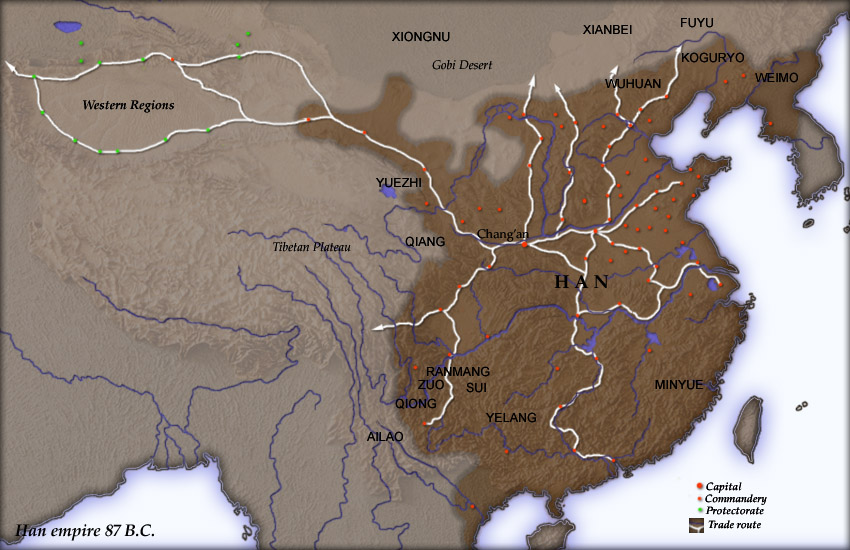
The Empire in 87 BCE
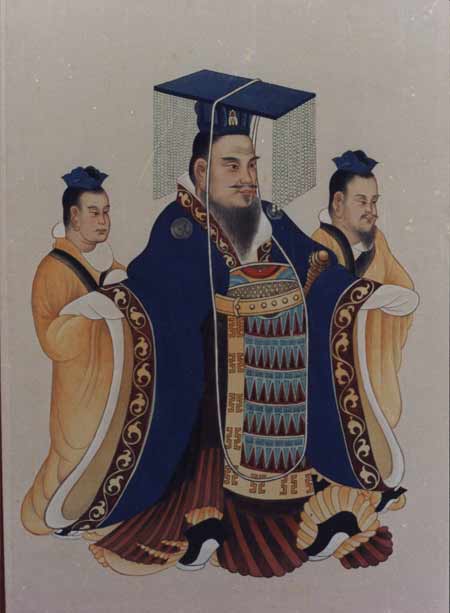
The high point of the Western Han Dynasty came during the rule of Liu Che, or Han Wudi, who ascended the throne in 141 BCE. Initially his grandmother ruled the Empire in his stead, but upon her death in 135 BCE, Han Wudi proceeded to make his own mark on the Empire.

Han Wudi
The first thing he did was take Dong Zhongshu into his confidence, and proceeded to overturn the old Legalist system, replacing it with a Confucian variant. Initially Confucianism had been a simple secular ruling philosophy, teaching filial piety and respect for authority. Under Dong Zhongshu, Confucianism was mixed with aspects of Daoism and Legalism, fusing the ethical though of Confucianism with the ideas of Yin and Yang, along with a cosmological framework into which fit Heaven, Earth, the Empire and the Emperor.

Having thus reformed the civil service, Han Wudi also expanded upon institutions made by Liu Bang. He formed the precursors to the later civil administration exams, ensuring that it was possible for promotion by merit, rather than birth.

The biggest legacy left by Han Wudi, however, was his military expansion. From 133 BCE until the end of his life, Han Wudi launched a series of campaigns aimed at expanding Han China's borders to the north and west, fighting the Xiongnu Confederation, a nomadic people of the steppe. Over a series of campaigns stretching from 133 BCE to 108 BCE the Han scored a series of victories that firmly established Han dominance of the North and West.

The campaigns continued until well after Han Wudi's death, ending in 89 CE.

Ultimately, the campaigns launched by Han Wudi ended up stretching the national treasury, and following his death in 87 BCE, the Western Han Dynasty began a long decay that ended in Wang Mang's Xin (or new) Dynasty.

Next week, we examine Wang Mang's Xin Dynasty!

(P.S. The reign of Han Wudi also saw the works of Sima Qian, known as the Grand Historian, published. He is the first historian in Chinese history)

Tuesday, January 14, 2014

The Chu-Han Contention

The Fall of Qin

With Qin Shi Huang's death in 210 BCE, the strong man who had unified China was gone. His sons were not up to their fathers' task, and the rise of Qin Er Shi in 210 BCE to the throne sparked a variety of rebellions. The first was in 209 BCE, which was put down by the Qin armies. However, this rebellion inspired a variety of others, and by the end of the year, most of the Qin Empire was in open rebellion, often led by those who claimed to be successors to the states that Qin had conquered to form the Empire.

Liu Bang

Liu Bang
Liu Bang was one such rebel leader. Nominally an underling of the state of Chu, Liu Bang was the one to march on the Qin capital in 206 BCE, forcing the surrender of Emperor Ziying (Qin Er Shi had been killed off and removed from the throne after his incompetence became clear). This marked the end of the Qin Empire, but not of the end of the chaos in China.

Said to be born in 256 BCE, Liu Bang was not from a noble family. Raised as a peasant, he had little time for the mannerisms and customs of the nobility. He rose to some prominence in his own little corner of the world, but when some slaves that he was tasked with escorting to construct Qin Shi Huang's mausoleum escaped, he freed the rest of them and became a fugitive to avoid the death sentence.

In 209 BCE with the first rebellions against the Qin, Liu Bang returned to his hometown of Pei County, and following the murder of the local magistrate by the civilians, declared himself Duke of Pei. In 208 BCE, Liu Bang swore himself to the service of Chu, and was granted the title of Marquis of Wu'an. At this point he was given an army and tasked with attacking Qin. To up the stakes, the King of Chu declared that the one who reached the capital first would be given the title of King of Guanzhong. The main contenders were Liu Bang and Xiang Yu, a general of Chu.

Liu Bang arrived first, and Ziying surrendered to him. By rights he should have been raised as King of Guanzhong as promised. However, Xiang Yu arriving second, was not content. He had the larger army, and the better connections, coming from a prestigious military family of the old Kingdom of Chu. At an event called the Feast at Hong Gate, he attempted to have Liu Bang assassinated several times, but each time was foiled.

Liu Bang, begging the use of the latrine, fled with his men west.

Xiang Yu

The opposite number of Liu Bang during the Chu-Han contention, Xiang Yu was a general and nobleman. Following the flight of Liu Bang, Xiang Yu, the strongest of the various warlords who had cropped up, broke the former Qin Empire into 18 parts, declaring himself ruler of 'Western Chu'. Liu Bang was instead relocated to Hanzhong in modern day Shaanxi, and given the title King of Han.

Modern day Hanzhong Prefecture
Xiang Yu was an able general, though cruel and rather ruthless (the accuracy of the stories of his cruelty are difficult to take at face value, however, due to his defeat by Liu Bang). Unlike Liu Bang who relied on more able advisers and generals, Xiang Yu instead tended to rely on his own ability. Where Liu Bang was charismatic, Xiang Yu was competent.

Xiang Yu

The Chu-Han Contention

When Liu Bei arrived in Han Zhong, he had the galley roads (wooden planks cut into the sides of the cliffs) destroyed, both to prevent future assaults into his territory and to convince Xiang Yu that he was content in his position.

When the new state of Qi rose in rebellion against Xiang Yu's hegemony in 206 BCE, Liu Bang seized the opportunity. At the behest of his general Han Xin he attacked Guanzhong, defeating the three former Qin generals who ruled there. 

In response to this, Xiang Yu sent an army against Liu Bang, and declared Zheng Chang as King of Hán. In the following year, Liu Bang moved against the states occupying the modern province of Henan, and the kings of Sai, Di and Henan all surrendered to him. However, Zheng Chang did not, and was defeated by Liu Bang's general Han Xin, and replaced by him as King of Hán.

The defeat of the Qi rebellion in the same year allowed Xiang Yu to concentrate on his Western border. However, by failing to appease the people and allowing his army to loot and plunder the state of Qi, he encouraged more rebellions, leaving a dangerous situation on his northern flank.

Seizing advantage of this, Liu Bang advanced on the Chu capital of Pengcheng with a large force and captured it. Official records state that he had an army of 550,000 with him on his march, raised from his own reserves and those of the surrendered kings. 

Hearing of the fall of Pancheng, Xiang Yu rushed back with a force of 30,000, surprising Liu Bang with a sudden attack and inflicting large casualties on Liu Bang's forces, and inducing Liu Bang to withdraw with only a small bodyguard. In the confusion, he also captured Liu Bang's family.

Following this battle, many of the surrendered kings defected to Chu. Things were looking pretty bleak for Liu Bang.

In the latter half of 205 BCE, Liu Bang's general Han Xin managed to open a northern front against Xiang Yu in a series of battles that saw Han Xin crowned as acting King of Qi in 204 BCE. Liu Bang, then besieged in Xiangyang (near modern day Zhengzhou, capital of Henan Province) managed to sleuth his way out of the siege, spreading rumours that made Xiang Yu dismiss some of his able advisers, before attacking Chenggao (also near modern day Zhengzhou). Combined with the successes of Han Xin in the north, this forced Xiang Yu to the negotiating table, where Liu Bang and Xiang Yu agreed to split China between them along an East-West axis. This is known as the treaty of Hong Canal which was signed in late 204 BCE.

In 203 BCE, whilst Xiang Yu was retreating eastwards, Liu Bang broke the treaty and attacked, requesting aid from his allies Han Xin and Peng Yue to form a three pronged attack on Xiang Yu. However, his allies did not mobilise their troops, and Liu Bang was defeated in the battle of Guiling (near modern day Zhoukou in Henan Province). 

Forced to retreat, Liu Bang sent messengers to Han Xin and Peng Yue, promising them titles if they assisted him. And so, in 202 BCE, armies advancing along three routes led by Han Xin, Peng Yue and Liu Bang attacked Xiang Yu again, trapping him in Gaixia (near Suzhou, Anhui province). Han Xin instructed his men to sing Chu folk songs to create the impression that Chu had already fallen to Han forces.

Many of Xiang Yu's deserted him as supplies ran low and morale plummeted. Even Xiang Yu's favourite concubine committed suicide, blaming herself for his defeat (She had been captured and used as bait to draw Xiang Yu into the trap). Finally, with 26 loyal retainers Xiang Yu broke out of the encirclement, and reached the north bank of the Wu river, where he made a last stand as his retainers were sent across the river, killing several Han soldiers before committing suicide.

With his death, Western Chu surrendered to Liu Bang, allowing him to unify China again and declaring the beginning of the Han Dynasty in 202 BCE, with his capital in Chang'an (modern day Xi'an, capital of Shaanxi Province). 

Next Week: IT'S FINALLY TIME! THE BIG (well one of them anyway) ONE! THE ONE WE'VE ALL BEEN WAITING FOR! THE HAN DYNASTY!

Wednesday, January 8, 2014

Rise of the Qin

The Qin Wars of Unification

In 247 BCE, Ying Zheng ascended to the throne of the State of Qin. Being 13 years old at the time, he did not wield proper power until 238 BCE, when he eliminated his political rivals. With help from his chancellor Li Si, Ying prepared a plan to unify China.

In 230 BCE the state of Qin launched a campaign of conquest against the state of Han, considered to be the weakest of the Warring States, and devoured it completely within the year. What followed were a series of conquests that lasted until 221 BCE, when, one by one, the individual states of China fell to the armies of Qin.

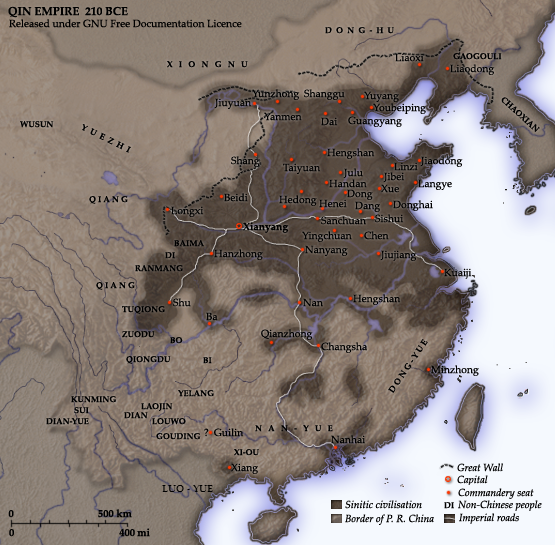
When the state of Qi at least surrendered to Qin in 221 BCE, Ying Zheng declared himself Qin Shi Huang, or the First Emperor of Qin, and became the first ruler to lord over a united China.

The Unified Qin Empire

Qin Shi Huang

Qin Shi Huang can be compared with two other (famous) figures in Chinese history - Cao Cao, and Mao Zedong. Born in 260 BCE, the man who would one day unify the Warring States was brought up in the state of Qin. The reign of Qin Shi Huang is noted in popular history for several important things.
  1. Its cruelty
  2. The construction of the (first) Great Wall
  3. The unification of weights and measures
  4. The unification of the written language
Though the Dynasty founded by Qin Shi Huang lasted only 15 years, it would have a lasting impact on the history of China. Indeed, the name 'China' itself can possibly be traced to the Qin (pronounced Chin), as a corruption of Central Asian terms for the Qin Empire.

The reign of Qin Shi Huang introduced the above four things to China. It also introduced to history a flawed man who likely killed himself looking for the Elixir of Immortality.

There were positives too, among all the misery and suffering. The bureaucracy was greatly expanded under the reign of Qin Shi Huang, and the old Feudal system, whilst not abolished, was greatly reduced in emphasis. Though the famed examinations were not implemented during the Qin Dynasty, governmental reforms made it easier to promote both military and civil administrators based on merit, rather than familial connections.

Confucianism and Daoism were suppressed - Legalism was the state philosophy, though Qin Shi Huang did allow for Daoist religious practice. As part of this, the 'Hundred Schools of Thought' was suppressed - and and many books were burnt, scholars who refused to give them up, buried alive in 213 BCE. There is some skepticism as to how extensive this book burning program actually was, as most of the alleged cruelty was against the scholars - the people who ended up writing the history of the Qin Dynasty from the safety of the Han Dynasty.

The Great Wall was originally 'constructed' during the Qin Dynasty as well. Not the stone monstrosity that you can visit today, the Qin Great Wall was a series of earth ramparts and clay fortifications, largely already constructed, that Qin Shi Huang ordered connected in order to secure the northern border. 

After three assassination attempts, Qin Shi Huang became paranoid and obsessed with finding the Elixir of Life, and employed a variety of Daoist priests who gave him elixirs that had a lot of mercury in them, ironically likely shortening his lifespan.

Eventually, he gave up with the whole idea of living forever in flesh, and started big projects, like the Terracotta Warriors and his tomb (which to this day has yet to be opened) which would allow him to rule for 'ten thousand years' in spirit form.

He died in 210 BCE at the age of 50, still on the quest for the Elixir of Immortality. His empire fell apart 4 years later, in 206 BCE.

Short-ish entry today, will have more to talk about next week with the Han-Chu contention.

Wednesday, January 1, 2014

The Warring States

I left off the last blog with an examination of the Art of War, and the ways in which it has influenced Chinese military history since its introduction in the Spring and Autumn/Warring States Periods. I'm going to give a brief overview of the Warring States, but will be focusing on two campaigns carried out by an alleged descendant of Sunzi (Sun Tzu), Sun Bin.

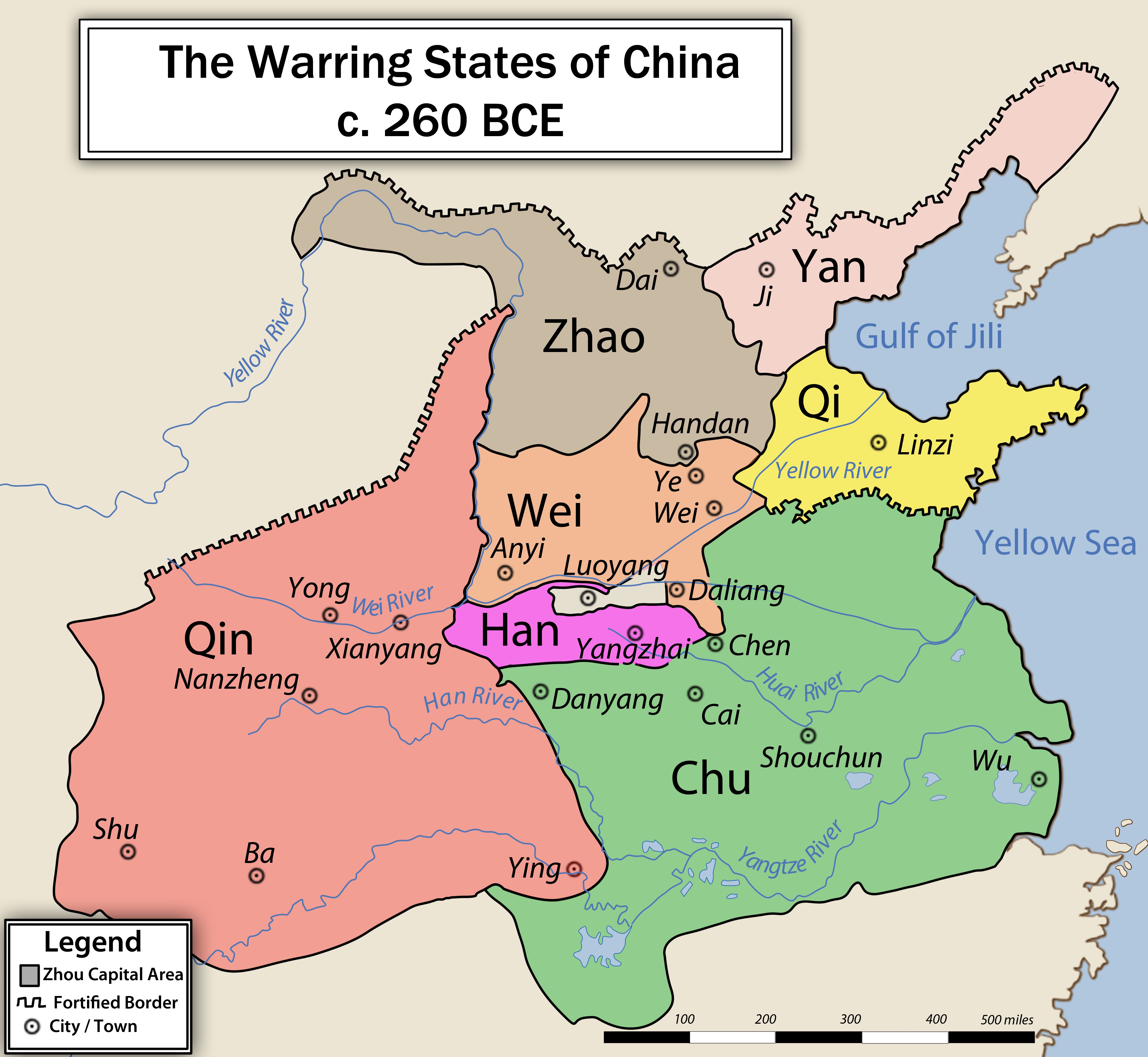
By the end of the Spring and Autumn Period, the various hundred odd states that existed in China had been whittled down to just seven: Qin in the west, the successor states of Jin (Zhao, Wei, Han) in the centre, Yan and Qi in the east and Chu in the south. The Zhou Dynasty kings were still technically in charge, and had their own little bit of territory near modern day Luoyang.
What's important to understand about the Warring States period is that, unlike the previous Spring and Autumn period, despite having more years of peace, the scale of war became increasingly larger, along with the casualties sustained by the various warring states. The exact date on which the Warring States period starts is a bit murky, as there lacks a clear event that marks the start time, unlike the fall of the Western Zhou Dynasty for the Spring and Autumn. Various dates have been suggested, from 481 BCE, which marked the end of the Spring and Autumn Annals, to 403 BCE, when the three states of Zhao, Wei and Han were recognised by the Zhou court. However, I personally prefer the date 453 BCE, which is the year in which Jin was partitioned into its three successor states. The period ends in 221 BCE, with the conquering of Qi by Qin armies, and the formation of the Qin Dynasty, the first dynasty that ruled over a unified China.

The Warring States Period is one of increasing bloodshed and destruction as the various states raise massive armies in their conquests of each other. Official numbers are generally thought to have been inflated, in order for the Han Dynasty to paint a picture of an extremely bloody period prior to unification. Remember that King Wu of Zhou had overthrown the Shang Dynasty with a force of 45,000 infantry and 300 chariots. Official figures for military might in the Warring States Period list the state of Qin as having an army of 1,000,000 infantry, 1,000 chariots and 10,000 horses. These numbers should be taken with a bucket load of salt, since they are likely inflated, but what can be inferred from this is that the scale of warfare increased at massively during the Warring States Period.

In terms of military technology, three things stand out. Firstly, the increased usage of iron in the process of forging weapons and armour, the invention of the crossbow, and the increased usage of cavalry to replace chariots. Although the primary metal used in the period was mainly bronze, at some point over the course of the 200 odd years of the Warring States Period, states shifted towards the usage of iron over bronze. The invention of the crossbow at some point during the 500s or 400s BCE enabled a shift away from aristocratic forms of chariot warfare, and towards the sorts of mass infantry armies that have become ubiquitous with perceptions of China. The decline of the aristocracy as a leader in terms of war making also enabled the development of dedicated cavalry forces, which were generally superior to chariots in that they were a more versatile fighting force.

The Warring States Period also saw a general spread in military philosophy, just as the Spring and Autumn had witnessed a plurality of moral and political philosophical thought. Of the Seven Military Classics of Ancient China, four are said to have been written during the Warring States Period. These are the Methods of the Sima, Wu Qi's Wuzi, Wei Liaozi, and the Three Strategies of Huang Shigong.

In terms of cultural development, the decreasing in stature of the aristocracy allowed for the development of a bureaucratic state, and the groundwork for the future Chinese bureaucracy were lain during the Warring States and Spring and Autumn periods.

Sun Bin

Said to have been a descendant of the famed Sunzi, Sun Bin (??? - 316 BCE) was a famed strategist of first the state of Wei, and then the state of Qin. Sun was tutored in military strategy by the hermit Guiguzi, and was considered to have been his best pupil. During his time with the hermit Guiguzi, he was good friends with another student named Pang Juan, and the two of them became sworn brothers.

Pang Juan soon left the tutelage of the hermit Guiguzi, and went off to the State of Wei, which he heard was recruiting talented men in order to conquer 'all under Heaven'. After a few years, with his star on the rise, he invited Sun Bin down to the State of Wei. But he was actually jealous of Sun Bin, who he knew to be the better general, and so he framed him for treason, and reported him to King Hui of Wei, who then ordered Sun Bin executed. Pang Juan pretended to be on Sun Bin's side, pleading for amnesty, and so the punishment was 'reduced' to face tattooing, and removal of Sun Bin's kneecaps.

Pang Juan then pretended to take pity on Sun, and treated him quite well, though he was in fact trying to trick Sun into writing a military book, after which he would have the man executed. Well, Sun figured this out, and decided to feign madness. Pang, not believing it, tried to test Sun's madness by locking him up in a pigsty, to which Sun pretended to be having fun and even ate pig feces. And so Pang stopped keeping an eye on him, allowing Sun to escape to Qi, where he eventually ended up as Chief Military Adviser.

In 354 BCE, Wei attacked Zhao, with Pang Juan at the head of the army, besieging the Zhao capital of Handan. Zhao asked Qi for help, and the King of Qi commissioned Sun Bin as military adviser, and Tian Ji as General to lead an army to assist Zhao. Knowing that a direct attack on Wei forces would be unwise, Sun proposed to attack Wei in order to relieve the pressure on Zhao.

In the Guiling Campaign, Sun first initiated a scattered series of attacks on Wei forts, all of them failing and luring Pang Juan into a sense of security, causing him to pool forces in the attack on the Zhao capital. Sun then had the Qi army attack the capital of Wei, Daliang. When word reached Pang at the Zhao Capital that Daliang was under attack, he marshaled a force to relieve the siege, and was decisively beaten at the battle of Guiling, where Sun Bin had prepared an ambush. From this campaign comes the 2nd of the thirty six stratagems - "Besiege Wei to Rescue Zhao". 

Pang managed to escape back to Wei, despite the destruction of his forces.

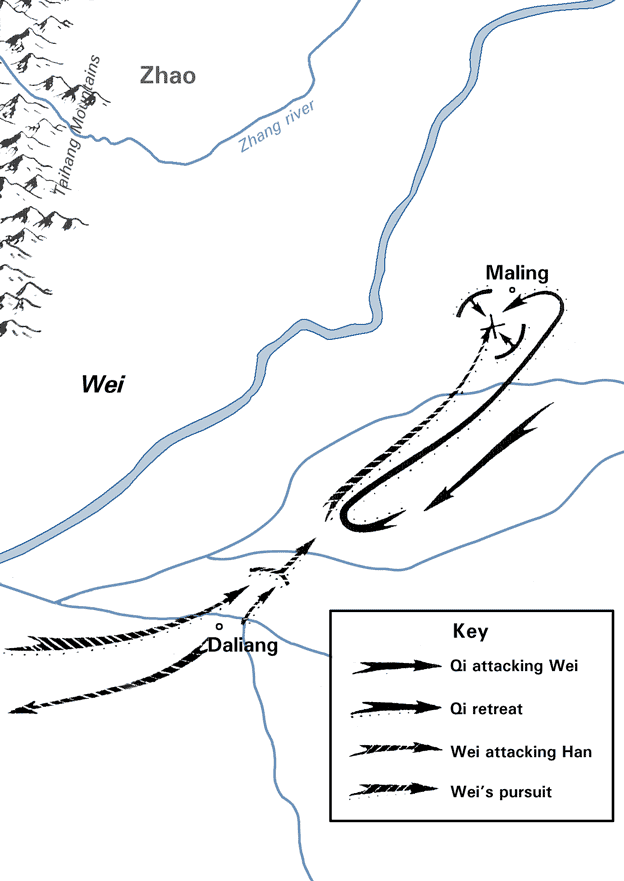
The second of Sun Bin's two famous campaigns, the Maling campaign took place in 342 BCE, when Wei attacked Han, and Han turned to Qi for assistance. Giving the impression that Han could depend on Qi's army for assistance, Han went all in against Wei, though the promised help never materialised. After a year of resistance, Han was no longer able to maintain its armies, and again asked for help from Qi. Again, instead of assisting Han directly, Sun advised to strike at the Wei capital of Daliang.

Having learnt from his mistake in the previous Battle of Guiling, Pang Juan (annoyed at having been recalled from the war in Han a few weeks away from taking the Han capital) ordered his 100,000 strong army to go around the Qi forces, to avoid ambushes, and also ordered his troops to return to the capital hastily, before Qi could set up any good ambushes.

Sun however, just sat and waited, rather than rushing around to attack the high morale Wei army. He then split his force, sending the majority of it back towards Qi to prepare the necessary materiel for ambushes, whilst he personally led a force to face Pang Juan. When the two armies came close to each other, Sun immediately ordered a retreat towards Qi.

Along the way, he ordered his army to reduce the number of stoves used for cooking day by day. Judging from the dwindling number of campfires, Pang Juan assumed that the Qi army was deserting, and so led a smaller, elite cavalry force to give chase. As the Qi army retreated back into their own territory, Sun then ordered the men to abandon some of their baggage. When Pang Juan's force happened upon this, they assumed that there existed a state of confusion in the enemy ranks. 

When the Qi army arrived at Maling, Sun Bin noticed a narrow path that could be used for an ambush, and so, judging that Pang Juan would arrive at nightfall, ordered his men to prepare for battle. Chinese folklore has it that he also ordered his men to inscribe on a tree "Pang Juan shall die in Malingdao, under this tree".

When Pang Juan arrived with his army, he was lured into the ambush, and, knowing that the battle was lost and escape impossible, took his own life.
Map of the campaign

The campaigns of Sun Bin reflect the trends of Chinese warfare found in the Art of War. Firstly, he focused mainly on the strategic aspects of the campaigns, willing to take defeats on a tactical level to shape his strategic goals. Secondly, he relied heavily on maneuvre to force Pang Juan to fight him on his own terms, attacking strategic ground and remaining agile in order to defeat a larger force. Third, as the retreat towards Maling shows, he made good use of 'shaping operations' in order to fight on the most favourable terms to him, engaging in ground of his choosing against an enemy tired out by pursuit. Finally, his heavy usage of deception in the Maling campaign reflects the famous Sunzi quote:
"All warfare is based on deception"
Next week I'll be taking a look at the Qin campaigns of unification, where we start to get into the proper, unified Chinese Dynastic history. Hope you enjoyed this blog post!

Monday, December 23, 2013

Sunzi

I know I promised last time to write about three titans of Chinese philosophy, but I found that attempting to tackle all three in one blog post would either create a summary barely worth anything, or make a post so long as to be unwieldy. Instead, I'm going to tackle Confucius later, when I get to an examination of Emperor Wu of Han, and talk about Sunzi now, since he will be quite influential during the examination of the Warring States period.

Do note that this will form the first of several blog entries dedicated to Chinese military history/theory, and I will endeavour to cite a bit better in it than I have been in the previous posts.

Sunzi (Wade-Giles: Sun Tzu), born Sun Wu, was a famous general of the state of Wu, traditionally considered to have lived from 544BCE to 496BCE. His most obvious claim to fame is that he is considered to have been the author of the Art of War 《孙子兵法》(sun zi bing fa). Although there is some debate over his having existed, it is generally agreed that he lived in the State of Wu in tail end of the Spring and Autumn period. His birthplace is disputed. The Spring and Autumn Annals state that he was born in Qi, whilst the Records of the Grand Historian claim that he was a native of Wu.
An artist's representation of Sunzi from a later dynasty
There is also some debate as to whether or not he penned the Art of War. Historian Ralph Sawyer is of the opinion that it is likely that Sun Wu both existed and penned the core of the Art of War, though he acknowledges that a fair amount of the text consist of commentaries and later additions to the core work (1).

Of Sun Wu's life, one memorable tale stands out. According to Sima Qian's Record of the Grand Historian, Sun Wu was tested by King Helu of Wu before being employed by him, giving him a harem of 180 women to train into soldiers. Sun Wu split them into two companies and appointed the King's two favourite concubines as officers. He then ordered them to face right, and was met by giggles. He stated that the general was responsible for ensuring that soldiers understood the command, and reiterated his order. They giggled again, and he then ordered the execution of the two 'officers'. Sun Wu insisted on his order when the King protested, stating that if the soldiers understood the general's commands and failed to heed them, it was the fault of the officers. He also maintained that once a general was appointed, it was his duty to carry out his orders, even if the king protested. Once the concubines were executed and new officers appointed, the rest of them followed the orders flawlessly.

The Art of War

No discussion of Sunzi is complete without a discussion of the Art of War. Divided into thirteen chapters, the Art of War is one of the foundation texts of the Chinese military canon. Combined with five other texts of the Spring and Autumn/Warring States Period and a later work from the Tang Dynasty, it forms an integral part of the Seven Military Classics. Despite what its name implies, the text touches on several points of governing a country as well as the role of the general in relation to the ruler.
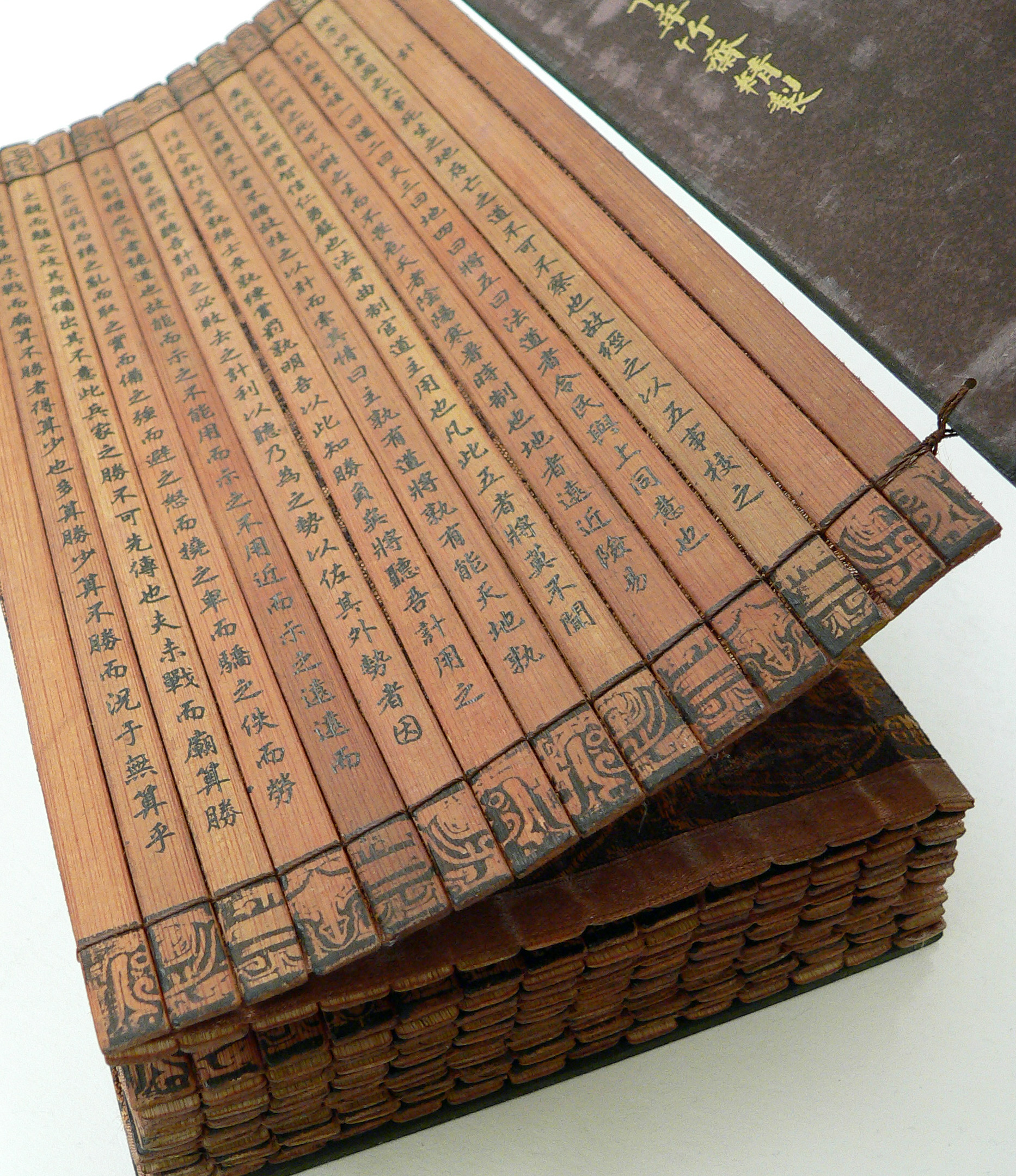
The Art of War on Bamboo pages
The Art of War is important in several ways. Firstly, it emphasises the strategic level of operations rather than the tactical. Second, it exalts the usage of maneuvre to outfox your enemy, rather than throwing bodies at him. Thirdly, the positioning of troops, the preparation of the field and the prior calculations to fighting are defined as equally as important if not more important than the battle itself. Finally, the importance of deception is talked about in large amounts as a foundation of warfare (2).

In relation to the larger strategic canon, the Art of War is reflective of how the Chinese wage war.

Firstly, the teachings within the Art of War have been exalted to a large degree by many influential military thinkers and generals throughout history. It is important to note however, that the teachings reflect the time period in which Sun Wu was writing. The strategies that form the core of the Art of War are useful primarily against other states with which one engages in war with. Various generals through history whom have had the task of pacifying the barbarian tribes to the north, primarily the Mongols, have had less than stellar reviews for the Art of War.

Beyond this, one may still see the influences of the Art of War on modern day Chinese strategic thinking. Above the campaigns of Imperial China, the influence of the Art of War can be seen in the Korean War, the Chinese Civil War and other campaigns fought by China in the 20th century.

There is much more that can be said of the Art of War, but this blog post is already getting on in length.

Further Reading

From Red Cliffs to Chosin: The Chinese Way of War - An excellent overview of the strategic development of Chinese military history over two thousand years. http://www.dtic.mil/cgi-bin/GetTRDoc?AD=ADA523450  

The Art of War - The text of the Art of War, worth a read, it's quite short. http://ctext.org/art-of-war/laying-plans

The Seven Military Classics - These were the texts that were required reading for the exams to get into military posts from the Song Dynasty onwards. http://www.amazon.com/Military-Classics-Ancient-History-Warfare/dp/0465003044/ref=sr_1_1?s=books&ie=UTF8&qid=1364082824&sr=1-1&keywords=seven+military+classics+of+ancient+china

References

1. Sawyer, Ralph D. (2007), The Seven Military Classics of Ancient China, 150-151
2. Pangelinan, Games G. (2010), The Chinese Way of War, 6-7

Wednesday, December 18, 2013

The Spring and Autumn Period

The Spring and Autumn period represents the zenith of Chinese philosophy and political thought. The decline in power of the Zhou Kings and the resultant rise of many disparate states formed an atmosphere where political and philosophical thought would be able to flourish in ways that would not be seen in China for centuries.

The Spring and Autumn is the period of Confucius, Laozi, Mozi and Sunzi. It saw the rise of the four main schools of philosophical thought that dominated the Spring and Autumn and the Warring States periods; Confucianism, Taoism, Mohism and Legalism. Of the two, only Confucianism and Taoism survive in recognisable form today.

Following the sacking of the Zhou capital at Zongzhou near modern day Xi'an by the Marquess of Shen and his Quanrong barbarian allies, the Zhou moved their capital eastwards, to Chengzhou in the Yellow River valley. This marked the ending of the Western Zhou Dynasty, and with it the ending of central Zhou authority. During the period in which the Zhou had consolidated their power upon ascending to primacy in China, states in the East had been carved up and given to members of the royal family. Though this had kept those potentially volatile states under Zhou control, by the fall of Zongzhou states that had once been ruled by royal brothers were now ruled by third and even fourth cousins.

Further complicating matters for the Zhou was the fact that their new capital was removed from their traditional power base in the Wei river valley. This double blow of a military defeat, combined with the removal of their power base meant that the Zhou were essentially reduced to a figurehead ruler of China.

The shifting of the capital occurred in 771BCE, and that is typically the date that historians associate with the beginning of the Spring and Autumn period. The name of the period comes from the Spring and Autumn Annals, a chronicle of the state of Lu between 772 and 479BCE. Traditionally, this piece of literature is ascribed to Confucius, but in reality was likely put together by chroniclers from the state of Lu.

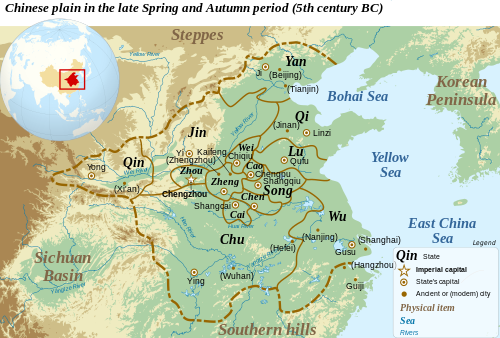
Courtesy of Wikipedia
Over the course of the Spring and Autumn period, some 148 states rose, though were eventually unified by one of the seven major states that would arise by the Warring States period. The Spring and Autumn saw several important changes to the traditional Chinese methods of governing.

Firstly, the Feng Jian or Feudal system that had been in place during the Western Zhou dynasty was rendered obsolete. The rendering of the King of Zhou to a figurehead meant that real power lay in the rulers of the various states that were now vying for hegemony in China.

Secondly, the rise of these various states led to the development of a hierarchical alliance system. In it, the strongest state leader would be given the title of Hegemon or ba, who would be obliged to protect the weaker Zhou states and the Zhou royalty from intruding armies. Whilst this still had shades of the old Feng Jian system, in reality the Zhou royalty were not as important in the determination of the hegemon as might be implied.

Thirdly, the rise to power of the first hegemon, Duke Huan of Qi (Qi Huan Gong) was due largely to reforms passed by his adviser, Guan Zhong. Among these was the centralisation of power in the hands of the state, direct levies applied to the villages to bypass the reliance on the aristocracy for manpower, he devised a better method for choosing talent to be governors. During his tenure, Qi shifted from a traditional model whereby the aristocracy was responsible for governing to a system of professional bureaucrats. He also created sponsored government brothels to fund the government treasury. He also created a uniform tax code and used state power to encourage the production of salt and iron.

The success of Guan Zhong led to the emulation of his policies, which contributed further to the decline of the Feng Jian system.

Somewhat unique among the major states in the period was the state of Chu, which was not considered to be part of the Zhou cultural group, and as such were regarded as barbarians. Indeed, the state of Chu was not subservient to the Zhou at all, declaring that its king was equal, if not superior to, the King of Zhou. Many of the wars waged by the hegemons were against the state of Chu.

Following the death of the second hegemon, Duke Wen of Jin in 628BCE, tensions that had been simmering in the central plans area began to rise, and constant skirmishing erupted between Qi, Qin, Jin and Chu. By the time those four states sat down to discuss disarmament, it had become readily apparent that the traditional role of hegemon was outdated, as each state had acquired their own spheres of influence. The integration of non-Zhou peoples into various states, combined with the occupation by Chu of various areas recognised as Zhou blurred the line between Zhou and non-Zhou peoples.

When Jin and Chu backed off each other, Wu in modern Jiangsu and Yue in modern Zhejiang rose. In 583BCE Jin negotiated an alliance with Wu, which meant that even as Jin and Chu agreed to a truce in 546BCE, Jin was able to fight a proxy war via Wu, peaking in a full scale invasion of Chu by Wu in 506BCE.

Even as this was developing, the power of the Jin dukes was declining, resulting in a civil war in 497BCE, which lasted until 453BCE, the results of which were the elimination of most noble lines. The remaining families divided Jin into three states: Han Wei and Zhao.

This left seven major powers in the Zhou world: the three partitioned states of Jin, the three remaining powers of Qin, Chu and Qi, and the weaker state of Yan near Beijing. This set the stage for the Warring States period, which will not be covered next. Instead, I will be examining a few of the major characters of the Spring and Autumn period, namely Confucius, Laozi and Sunzi.